
RIGRI at the 56th Annual ASEEES Convention

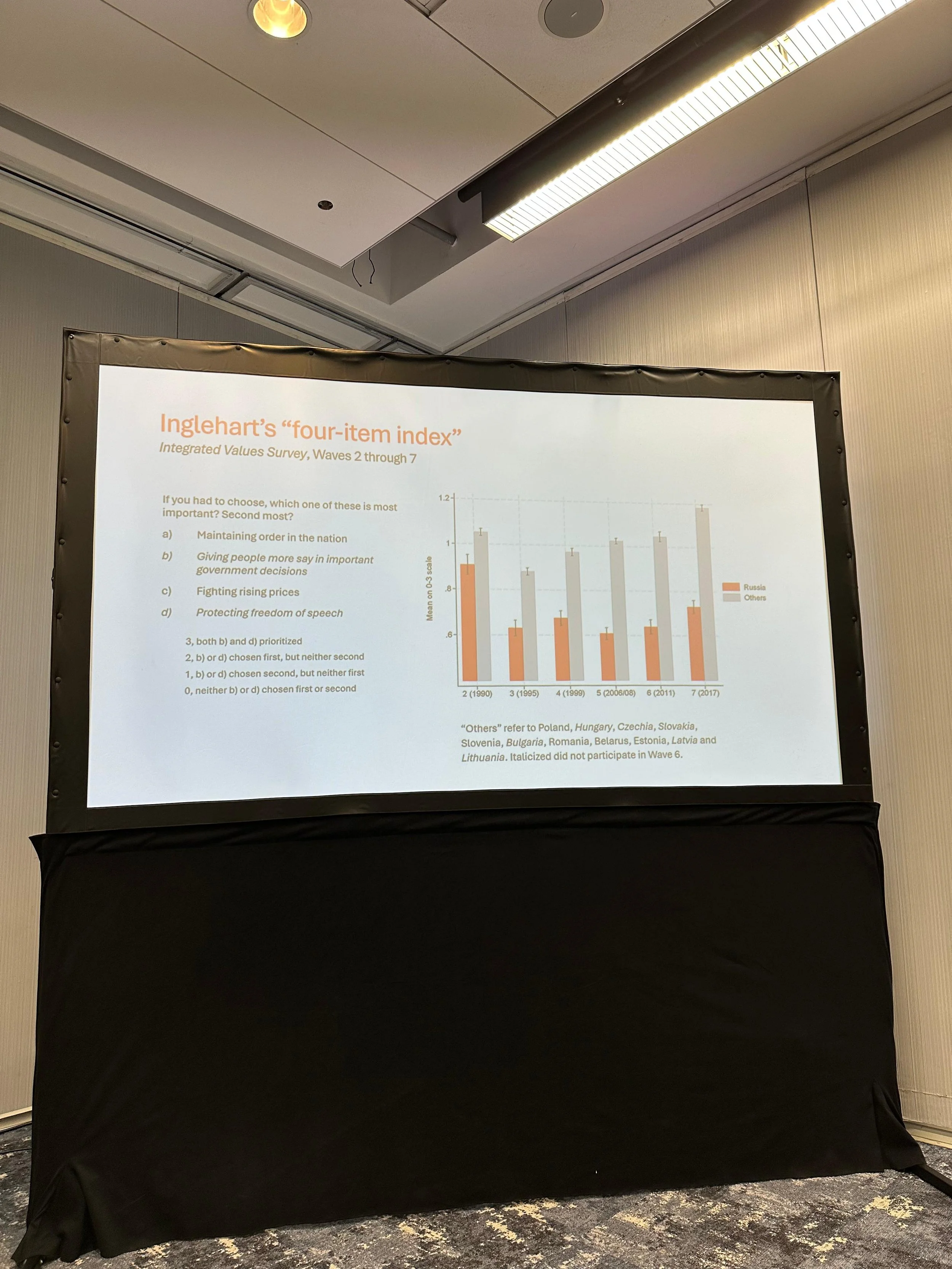
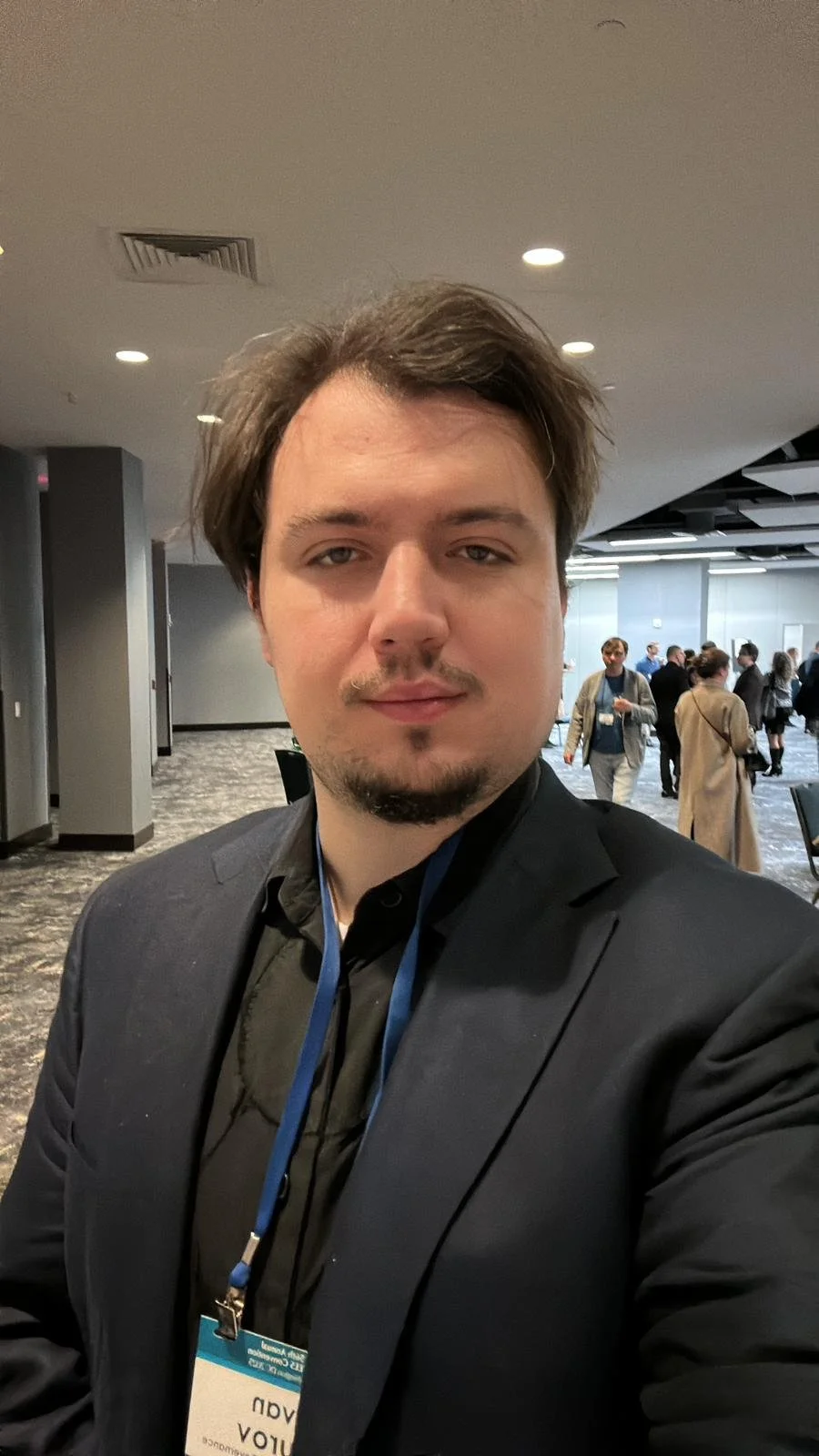
Russian Identity and Governance Initiative (RIGRI) attended the 56th Annual Convention of the Association for Slavic, East European, and Eurasian Studies (ASEEES), held at the Washington Hilton in Washington, D.C. At the convention, RIGRI was represented by Ivan Yurov. We aimed to learn about current debates in Russia studies and to introduce RIGRI as an independent organisation capable of advocating new perspectives on Russian identity, separate from Russian Federation governance practices. The event featured numerous panels based on case studies.
Although RIGRI has attended more panels that are about to be described, the panels below were the most relevant to the topics of Russian identity and governance of Russian Federation. The panels addressed the memory points the state appeals to the people: domestic to keep the state and military functioning, and international to make them susceptible to Russian Federation’s narratives.
1) What Memories and Imaginations Motivate Russians to Fight in the War? Application of Machine Learning in the Study of Ideology by Ivan Grek
This research examines the beliefs that drive Russian soldiers on the Ukrainian battlefield, shaping their ability to legitimise and normalise the war. Using cognitive linguistics and machine learning techniques, it analyses over 500 YouTube interviews with Russian prisoners of war and cross-references findings with a BBC database of over 55,000 confirmed Russian casualties to understand soldiers' sociodemographic profiles. It uses digital methods to instrumentalise the theory of “lifeworld” (Lebenswelt), identifying cognitive models that shape their perspectives.
Following the clarifying questions, the panel concluded with the notion of what the Russian soldiers generally believe about Ukraine. The finding is that they know the concept of the former common territory, as told by their relatives who experienced it, not what they are opposing. As that generation fades, the public’s unconscious sense of a claim to Ukraine and the reunification narrative might erode with it.
2) Failure: Russia Under Putin with chapter discussion by Peter Clement and Steven Allan Fisher
When discussing the book, the authors indicated that key failures of Russian Federation under Putin and sought to explain what prompted Putin to launch the current invasion of Ukraine. With the key statistics and decline, the key question RIGRI could ask was to attribute the key failures in Russia, which the author has outlined as demography and Science & Technology, especially noting the inability to establish a functional microchip production.
According to Peter Clement, Putin is obsessed with legacy, and his vision of Russian Federation includes the subjugation of Ukraine. Fuelled by a perception of chaos in the West and skewed data about Ukraine, Putin believed in the window of opportunity. The other part included the idea of Putin’s ‘turning points’ as he hardened his views on international cooperation with the US/NATO and Ukraine, with 2004 both experiencing the US hosting Chechen exiles during Beslan and an Orange Revolution in Ukraine. RIGRI would like to apply this notion of turning point for Putin, but for the domestic politics, which RIGRI believes to have solidified in 2011.
3) Russia’s Rediscovery of its Soviet Anticolonial Language and its Adaptation to the Global South by Marlene Laruelle
The paper addresses Russian Federation’s genealogy of anticolonial discourses inherited from Slavophile and Eurasianist thinkers and merged with Soviet-time internationalism. It looks at the main iterations of it in today’s Russian Federation, ranging from official strategy by figures such as Sergei Karaganov to more fringe Dugin’s versions and explores the idea of a metapolitics of multipolarity and its receptions in the Global South and among the non-liberal West.
Russian Federation is using ‘modular anticolonialism’ that can be left or right-leaning, depending on the target audience, as long as it opposes the ‘liberal West.’ It means that ultimately, there cannot be an ideology in Russian Federation since that would ruin the adjustable approach Russian Federation is using. Exposing those contradictions is the path towards subverting the state narratives.
4) Parallels Unexpected: A Comparative Analysis of the Dark Enlightenment in the United States and Russia by Ilya Budraitskis
This panel examined the concept of the Dark Enlightenment as it manifests in both the United States and Russia, offering a comparative analysis of its intellectual foundations and policy implications. The Dark Enlightenment, as defined in this discussion, refers to a philosophical and political movement that advocates for a reactionary revolution, emphasising the reintegration of metaphysical and sacred dimensions into political discourse. The discussion will explore the ideological origins of this movement, its contemporary expressions in both countries, and how it has influenced or intersected with political thought and policy. Particular attention will be given to the movement’s engagement with technology, its historical roots in the countercultural movements of the 1990s, and its positioning within broader conservative frameworks. Additionally, the roundtable will assess the extent to which these movements engage in dialogue, influence each other, or exist in opposition, as well as the competition between their respective messianic visions.
Following the question on the nature of the ‘Antichrist’ rule and how it differs from the religious perception. The author clarified that in Thiel’s vision, the ‘antichrist’ rule can potentially be permanent. Perhaps an appeal to religious identity alongside Russian Federation’s multicultural governance can be used to discourage a notion of Russian Federation as a restrainer/katechon that the Russian people must support.
5)Authoritarian Legitimation through Russia’s Rhetorical and Institutional Resistance to the International Criminal Court by Yuliya Zabyelina
This article explores the phenomenon of legitimation in Russian Federation, with a focus on its resistance to
the International Criminal Court (ICC) during its investigation into the situation in Ukraine.
Authoritarian legitimation is conceptualised as the strategic use of rhetorical and institutional
mechanisms to justify state authority, consolidate domestic support, and evade international
accountability. Drawing on an analysis of Russian-language media, including state-controlled
outlets and social media from 2014 to 2024, the article examines how rhetorical strategies
shape public opinion, amplifying appeals to patriotism and sovereign exceptionalism to
legitimize non-compliance.
The analysis also considers legal changes as part of the institutional
mechanisms of authoritarian legitimation, illustrating how the Kremlin leverages laws and
institutions to reject ICC jurisdiction and reinforce state control. By situating these strategies
within the broader framework of authoritarian legitimation, the article underscores the
adaptability of authoritarian regimes in undermining global justice while sustaining domestic
governance. This analysis enhances understanding of the interplay between law, politics, and
media in shaping the global landscape of criminal justice. The panel clearly outlines that the state of Russian Federation wants to maintain an image of a ‘collective Putin’ as a manifestation of Russian identity. And supporting this narrative has one key beneficiary: Putin.
6)On Rubber Stamps and Mad Printers: Authoritarian Parliamentary Activity and the Case of the Russian State Duma by Julian G. Waller
Parliamentary activity is the active exercise of procedural and political prerogatives assigned to
a parliament and/or its members through constitutional privilege or internal standing orders.
Occasions of politically relevant parliamentary activity are relatively rare in non-democratic
systems, and their outcomes are often ultimately quixotic under such conditions. Yet many long-lasting electoral authoritarian regimes have found themselves startled by one or another such form of parliamentary political activity, whether constructive or destructive. This paper investigates the conditions and means by which parliamentary bodies in electoral
authoritarian regimes activate in this way as sites of inter-elite contention, opposition
obstruction, or loyalist policy-making activity. To do so, this paper engages in a theory-building
exercise, using a qualitative analytic narrative of the Russian Federation’s State Duma as a model case for
longstanding electoral authoritarian rule. It finds evidence to support a structural-institutional
theory of authoritarian parliamentary activity, and concludes with further avenues for research.
Although the question about further clarification of the state of parliament regarding lobbying remained unanswered, the panel enhanced the understanding of governance in Russian Federation. As parliamentary activity increases during uncertainty due to more ways to prove yourself and get closer to the president, it indicates reduced stability. Furthermore, the current parliamentary model has shifted to a bureaucratic one that optimises laws, especially financial. The previous ‘rubber stamp’ model proved less effective, requiring more resources to be allocated by the presidential administration.
7) Helping the Course of History: Russia’s Promotion of Pro-War Narratives through Local Cultural Engagement by Rebecca Adeline Johnston
For years before its full-scale invasion of Ukraine, the Russian Federation government became increasingly preoccupied with promoting a conception of national unity that justifies territorial expansion. One of the ways it has sought to encourage that conception of unity is through state-sponsored cultural production that rewrites historical narratives and encourages military mobilisation. Much recent scholarship has explored the Russian Federation government’s promotion of historical narratives that frame Ukraine as essentially “part of Russian Federation.”
Due to a high level of financial dependency, the Russian Federation has a sprawling national network of cultural institutions that it can deploy to promote these narratives locally. This paper will show that the state has utilised this cultural network to directly engage local populations and transform the promotion of these narratives into a collective, personalised, reifying experience. This panel examined how the state of Russian Federation justifies its narratives, focusing on unity and ‘reunification’, even with an imperialistic twist. The example was a short movie, Kongurei, where Tuvan clans and territories are about to be ‘reunited’ within Russia.
Overall, the convention has met RIGRI expectations. Our organisation can hear the current discourse that enhances the understanding of how Russian Federation and Russians are perceived. Fortunately, most panellists understand the need to distinguish Russians as a population from the governance practised by the Russian Federation state, and how the state aims to be perceived as acting on behalf of Russians. The key state message is that of ‘reunification’ in a multicultural state that provides no further details. Panels were unified by a focus on authoritarianism and the tools it deploys. Russian Federation flouts international law, constructs misleading identity-based propaganda, and reinforces the bureaucratic apparatus. Simultaneously, Russian Federation continues to integrate into the globalised world and works effectively to circumvent both sanctions and Western messages. Russian Federation also adopts new approaches and strategies to sustain the war and suppress the population, which is especially important with the emergence of technological methods of control, such as AI.
RIGRI met new potential contacts and perhaps contributors among the panellists and attendees. RIGRI plans to apply these findings to the next analysis work and build up the organisation to the point of being a panellist in the future.